

Love This Blog? Sign Up for Our Newsletter for More
SignupNo items found.


Summary:
Your first call might not close a deal, but it strongly influences whether the relationship moves forward. Reaching out to prospects quickly while optimizing call deliverability and quality boosts your team’s chances of getting live answers. Once prospects answer, using clear openers and small micro-commitments build momentum and make it easier to secure next steps.
Most sales teams don't try to close deals on the first call. Unless you’re selling something with a relatively low barrier to entry, your customer probably needs an evaluation period to get the necessary approvals or compare their options.
That means your sales cycle probably spans many conversations. Your first call is more likely to be about getting a meeting on the calendar, qualifying interest, gathering context, or setting expectations than trying to ink a deal right away.
But no matter what goal you have for that initial call, it will likely have an outsized impact on the rest of the deal. Prospects make decisions quickly and form impressions even faster. You need to time your outreach properly, optimize call deliverability, and be prepared for a live conversation if you want to seize the moment.
Below, we show you the strategies that give sales reps the best shot at success on a first call. You’ll also learn how to use PhoneBurner’s power dialing platform to put those strategies into practice at scale.
Rapid response to contacts who have opted-in to receive your communications is a key driver of better outcomes. That’s because inbound intent decays fast.
The longer a lead waits after submitting a form or requesting a callback, the lower the odds that they’ll pick up the phone when you call, and the lower the odds that your first call will result in a positive outcome.
Teams that respond within minutes consistently convert more than teams that respond within hours. Research from MIT shows that your odds of successfully calling to contact a lead decrease by over 10 times during the first hour, and the odds of calling to qualify them drop by more than six times during the same period.
Another reason speed to lead matters? Most prospects evaluate multiple solutions at once. The longer you take to respond, the more likely they’ll engage with one of your competitor first, which tilts the odds squarely in their favor.
Bottom line: waiting until “later that day” isn’t enough anymore.
Speed shapes perception. When you contact a lead quickly, it tells them you’re attentive, organized, and that you value their time.
Those impressions carry downstream into the rest of the relationship.

PhoneBurner’s power dialing platform is designed to help reps reach leads up to 4x faster and deliver more live conversations that move deals forward. The platform’s Leadstream feature provides one of the best ways for teams to reach leads before they go cold.
Leadstream is an automatic lead distribution engine that gives admins the ability to distribute leads according to custom rules. This prevents them from sitting idle and keeps reps consistently working the freshest opportunities.
Roughly a third of all calls across the platform happen through LeadStream. This shows how vital structured speed-to-lead processes have become in outbound phone sales.
Research from the University of Glasgow suggests that people form judgments about how trustworthy you are within 500 milliseconds of hearing your voice. On the phone, this means your greeting, tone, and clarity matter immediately. If those first few moments feel hesitant, muffled, or confusing, you have to dig yourself out of an unnecessary hole.
High-performing reps know this. Their openers are confident, direct, and polished. But a strong opener only works if the technology connecting the call doesn’t undermine it.
Learn More: How to Craft the Perfect Opening Statement for Sales Calls
Predictive and multi-line dialers often introduce a short delay before the rep hears the contact say “hello.” That delay is so common that many prospects instinctively associate it with telemarketing. Even a fraction of a second of silence can trigger thoughts like:
PhoneBurner avoids this problem entirely. Because our power dialer uses true 1:1 dialing, your reps are already on the line before the call is placed. Combined with Tier 1 carrier support, this helps ensure your calls connect instantly without pauses, beeps, or dead air.
That difference matters. When a call starts naturally and a human speaks right away, prospects are far more likely to stay engaged for the opener.
What your rep says is important, but you also need to do everything you can to make sure the prospect sees the call in the first place and trusts it enough to answer.
Numerous different factors can influence this, but two of the most important ones are spam flags and CNAM issues.
Spam flags are a major threat to answer rates, and can affect numbers even when reps believe they are doing everything correctly. Carriers and analytics engines flag numbers based on traffic patterns that appear risky from their point of view, like:
Once a number is flagged, the odds of a pickup tank. Explore this article by our sister platform, ARMOR®, for more information on the factors that can contribute to spam flag risk:
25 Factors That Can Drive Up Your Spam Flag Risk & How the ARMOR®️ Platform Helps You Avoid Them
As a 1:1 dialer, PhoneBurner supports healthier, safer dialing practices that drive better results. Connections are 100% delay-free. Traffic patterns often look more natural because reps are placing one call at a time. The risk of dropped calls, a frequent issue with predictive and multi-line platforms, is eliminated.
Our optional ARMOR® service also helps you detect and remediate spam flags that appear on your numbers. Our team can perform ongoing monitoring for numbers purchased through the platform, and work directly with carriers on your behalf to remove false flags. You’ll also get powerful call performance analytics – including data on optimal call times, call duration statistics, and other metrics that you can use to improve your calling practices and strengthen the reputation of your numbers over time.
CNAM is simply the “name” that carriers display when the call appears. This is a separate system from spam flags. Even if a number’s reputation is perfectly clean, CNAM identity problems can still create confusion for prospects and result in lower answer rates.
Common CNAM issues include:
This is a trust problem, not a deliverability problem. When the caller name looks wrong (or isn’t displayed at all), prospects hesitate to pick up, especially on a first call.
PhoneBurner can handle CNAM registration for numbers purchased through the platform, improving the name that appears for tens of millions of premium caller-ID users. We can:
A clear, consistent CNAM gives prospects a reason to trust the call, especially during first contact.
Number reputation and Caller ID are only part of the call deliverability picture. Modern smartphones now add another layer of gatekeeping through filtering systems like Call Screening for iOS 26, which prompts the caller to identify themselves and explain why they’re calling before the contact’s phone even rings.
Predictive and multi-line dialers fail here because there’s no live agent present when these features activate. That means the calls never reach the point where the contact can answer them.
Learn More: iOS 26 Just Changed the Game—Will Your Cold Calls Survive?
PhoneBurner’s 1:1 dialing means your agent is on the line when the call is presented to the device. That means they can immediately respond to the Call Screening prompt to provide context for the call.
They can also leave a manual voicemail message (giving the prospect time to answer), or quickly leave a pre-recorded message using PhoneBurner’s disposition buttons to save time. In any of these cases, their message is far more likely to reach the contact and move the conversation forward.
Learn More: PhoneBurner’s 1-Click Voicemail vs. Ringless Voicemail Drops: What’s Best?
Even once you’ve mastered speed-to-lead, optimized the deliverability of your calls, and learned how to deliver a trustworthy opening statement, you still need to guide that first conversation towards a favorable first impression and concrete next steps.
One of the most reliable ways to build momentum is through small, low-friction commitments. This is sometimes called the “Yes Ladder” or the “foot-in-the-door” effect.
Humans prefer consistency. When someone says “yes” to something small, they’re more open to saying “yes” to a slightly larger request immediately afterward. This holds true even on first calls.
Examples:
These micro-commitments set the stage for scheduling a demo, booking time on the calendar, or completing the qualification process. They may not help you close the deal the first time you call a prospect, but they shape buyer behavior and ultimately set the stage for success.
Learn More: Make the Sale: How to Prime Prospects with the "Yes" Ladder
Teams that consistently nail the first call do five things exceptionally well:
PhoneBurner helps teams improve every aspect of this framework. With LeadStream, 1:1 power dialing, ARMOR® number protection, a Tier 1 network, and productivity features built to support healthy calling patterns, teams can improve both reach rates and the quality of first-call conversations.
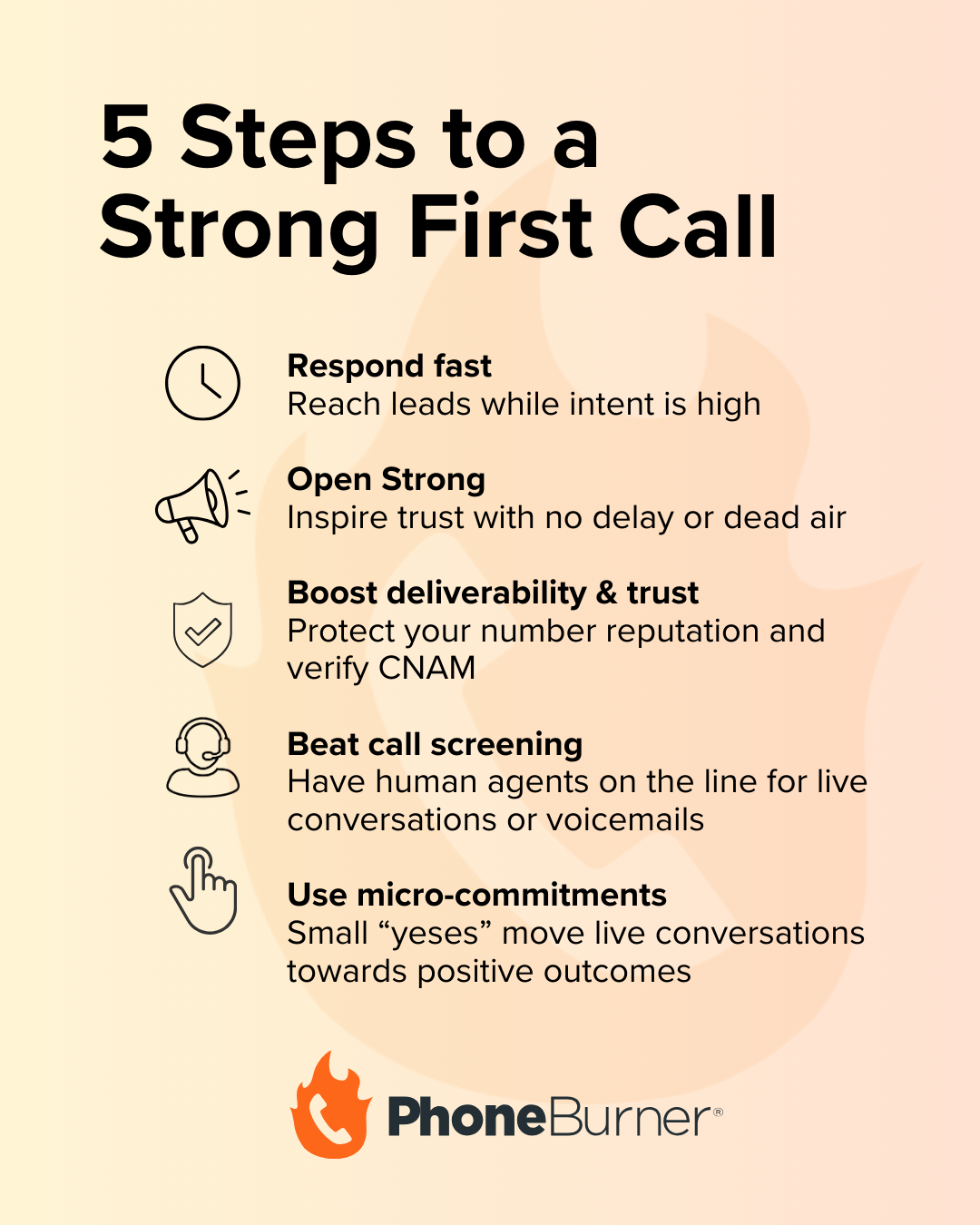
A strong first call doesn’t guarantee a deal, but a weak one almost always guarantees you won’t get another chance. Speed, clarity, connection quality, trust signals, and psychological momentum all play a role in whether the conversation moves forward.
With the right processes and technology in place, your team can make every first call sharper, more consistent, and more productive. In a world where reaching prospects is harder than ever, that’s a major advantage.




.jpg)
.png)
.png)

.png)

